
Our Footprint
Innovation
GREEN CHEMISTRY IN RARE DISEASE THERAPY: Patient-Centric and Environmentally Preferable
Apr 07, 2026
7 Min Read
The fields of chemistry and material science advanced beyond anyone’s wildest dreams but came with a price — waste and hazardous materials that weren’t foreseen or understood.… Now we recognize the power and potential of creative design, rather than believing the old myth of a trade-off between environment, health, and economics.
The fields of chemistry and material science advanced beyond anyone’s wildest dreams but came with a price — waste and hazardous materials that weren’t foreseen or understood.… Now we recognize the power and potential of creative design, rather than believing the old myth of a trade-off between environment, health, and economics.
Modern synthetic chemistry has delivered life saving medicines — but it can also leave a legacy of waste, bioaccumulation, and toxicity.
Green chemistry emerged in response to this challenge, redefining how chemicals are designed and manufactured to reduce or eliminate hazardous substances from the start.[1]
Since our founding, United Therapeutics (UT) has held a clear conviction: improving human health shouldn’t come at the planet’s expense — and that responsible innovation is a competitive strength. In 2021, we strengthened that commitment by becoming a public benefit corporation (PBC) — requiring us to balance patients, people, planet, and shareholders in how we make decisions and deliver results.
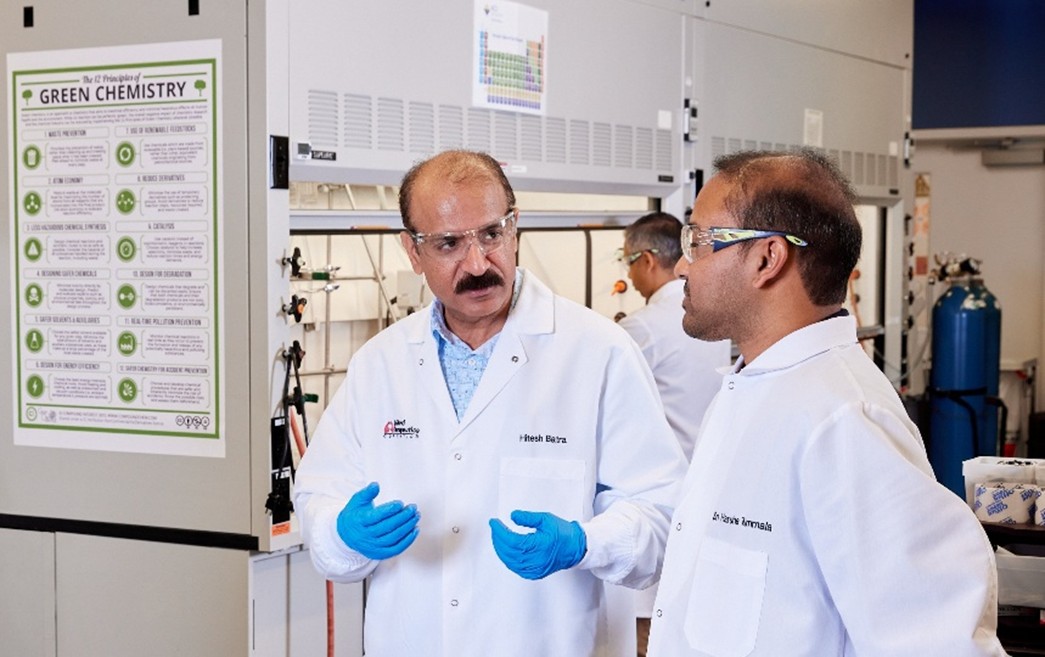
“As a PBC, we are committed to creating a brighter future for patients while recognizing the deep connections between human health and environmental impact,” said Dr. Hitesh Batra, VP of Chemical R&D and Production. “Applying green chemistry principles aligns with our purpose — and it is simply the right strategic choice for long-term impact.”
In anticipation of commercial-scale manufacturing of ralinepag – an investigational, once-a-day oral prostacyclin agonist, for the treatment of pulmonary arterial hypertension (PAH) – the R&D team redesigned the legacy manufacturing process using green chemistry principles. PAH is a rare, potentially fatal disease affecting approximately 50,000 people in the United States each year. It also reduces pollution at its source and minimizes the use and generation of hazardous substances while increasing batch output, lowering greenhouse gas (GHG) emissions, and reducing potential occupational health and safety risks to employees managing the process.
In its phase 3 clinical study, ralinepag demonstrated durable efficacy in delaying disease progression. UT intends to submit a New Drug Application to the U.S. Food and Drug Administration by the second half of 2026.
Prevention is Key
The U.S. Environmental Protection Agency introduced the idea of green chemistry in response to the Pollution Prevention Act of 1990, which encouraged eliminating pollution through better design rather than treatment and disposal.1
In the 1990s, international collaboration accelerated growth in the field of green chemistry, leading to the publication of the12 Principles of Green Chemistry in 1998. These principles gave green chemistry a clear framework to guide research, design, and innovation.
Prevention — the first of the 12 Principles — played a central role in our team’s redesign of the ralinepag manufacturing process.
Challenges with the original process: The legacy route is long, complex, and inefficient. It creates impurities that required added cleanup, reducing yield and increasing in process testing. It also relies on harsh reagents and conditions — creating added risk for employees, especially at scale. Finally, redundant steps add time and complexity without improving quality, lengthening timelines and reducing usable product.
What changes with the new process: The redesigned route cuts unit operations from nine steps to six. A new starting material blocks impurity formation early, removing downstream cleanup steps, reducing waste, and avoiding many harsh chemicals — while preserving product quality.
Environmental and safety improvements: The new process reduces chemical inputs by about 24%, using far fewer hazardous and corrosive chemicals, replacing more toxic solvents with safer alternatives, and avoiding toxic byproducts. These changes improve worker safety and significantly reduce hazardous waste.
Efficiency and climate benefits: The streamlined process uses less material, produces on average 55% less waste, and finishes more quickly. It produces more product per batch and requires fewer production days. Because fewer batches are needed, overall energy use is lower than the legacy process, leading to lower GHG emissions.
Cost and operational benefits: By cutting waste, labor for in-process testing and associated administrative oversight, energy use, and repeated steps, the new process is also less expensive. These savings free up resources that can be reinvested in research and development.
Small and Meaningful
The redesigned ralinepag manufacturing process demonstrates how deliberate, science‑driven innovation can deliver meaningful environmental, operational, and safety gains in pharmaceutical development. By rethinking the route from the molecular level upward, the new process will eliminate impurity-forming pathways at their source, streamline unit operations, drastically reduce hazardous inputs, and cut waste generation and energy consumption — all while improving yield, shortening process time, and strengthening operator safety.
For a rare disease therapy like ralinepag — where production volumes are modest but the importance to patients is profound — these improvements matter. By designing out hazards rather than managing them downstream, this innovation showcases the power of green chemistry to support product quality, reduce environmental burden, improve worker safety, and strengthen long‑term scalability and reliable supply as demand grows.